Scene Pacing and Runtime: What 271 Screenplays Actually Tell Us
Everyone says audiences have no attention span. But the same people watching reels are binge-watching prestige TV and listening to 4-hour podcasts. We analyzed the 271 films benchmarked on Quanten Arc. The findings are not what you expect.

There is a widely held belief that modern films are cut faster, more fragmented, more relentless than they used to be. Shorter attention spans, streaming platforms, the TikTok effect. The assumption is everywhere.
We decided to test it against real data. 271 films in the Quanten Arc library, analysed scene by scene.
The findings are not what most people expect.
Films are not getting faster. Genre is the real driver.
When you look at the raw decade numbers, modern films appear slower than films from the 2000s. The median scene duration has moved from 45 seconds per scene in the 2000s to 62 seconds in the 2020s. But that finding almost entirely collapses when you control for genre mix.
The 2000s sample is small and skewed by a handful of Paul Greengrass films. The Bourne Ultimatum runs 349 scenes across 115 minutes, a new scene every 20 seconds. The Dark Knight logs 394 scenes across 152 minutes. These are not generational data points. They are outliers defined by a specific directorial philosophy: geographic fragmentation as a storytelling tool. Every cut to a new location is a scene heading in the screenplay, and that shows up unmistakably in the structure.
When you strip those out and compare like for like, the era effect largely disappears.
What you are left with is genre.
Genre breakdown: fastest to slowest (2010 onwards)
Action films average a scene change every 40 seconds. Horror sits at 48 seconds. Thriller at 51 seconds. Drama, which makes up the largest single slice of the catalogue, comes in at just over a minute per scene. And Animation is the slowest of all at 80 seconds per scene setup, which makes sense when you consider the production cost of every new CG environment.
The one scene per minute rule of thumb that gets passed around screenwriting circles is a reasonable baseline for Drama specifically. For Action, the expectation should be closer to one scene every 40 seconds. For Animation, you have considerably more room.
These are not arbitrary craft preferences. They are patterns that emerge consistently across hundreds of produced screenplays.
At the extreme ends of the spectrum, the data tells its own story. The three fastest films in the catalogue are The Bourne Ultimatum, The Bourne Supremacy and The Dark Knight. At the other end: The Seed of the Sacred Fig at one scene every three minutes, Priscilla, Wild Tales. Slow Cinema, long takes, scenes that breathe. The screenplay structure reflects the editorial philosophy before a single frame is shot.
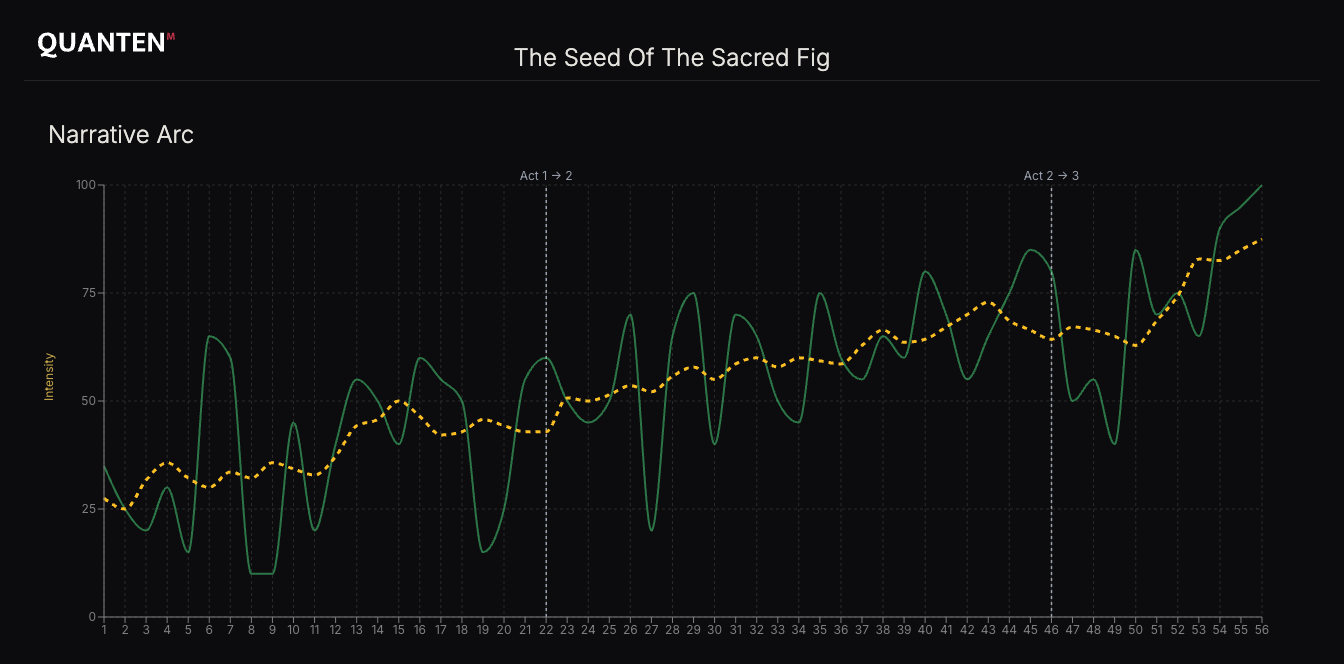
Pacing is not just an editing decision. It starts on the page.
Runtime: the two-hour contract is holding, but genre is pulling in opposite directions.
Across all 271 films in the catalogue, the median runtime has barely moved in 25 years. Films from the 2000s averaged 119 minutes. Films from the 2020s average 117 minutes. On the surface, nothing to see here.
Underneath that stability, genre runtimes are diverging sharply.
Action films are getting significantly longer. The median Action runtime has grown from 118 minutes in the 2000s to 149 minutes today. A full 30 minutes added in two decades. Combined with faster scene pacing, modern Action films are denser and longer simultaneously. More setups, more ground covered, more runtime to fill.
Horror has undergone the same expansion. From a median of 86 minutes in the 2000s to 130 minutes in the 2020s. The era of the 90-minute slasher has given way to prestige horror with room to breathe and build dread.
Drama and Comedy are moving the other way. Drama has trimmed from 126 minutes to 118 minutes. Comedy has dropped from 114 minutes to 105 minutes. Both genres are converging on a tighter, leaner format. For Comedy in particular, the streaming era seems to have enforced a discipline that theatrical releases did not.
Crime is the sleeper trend. From 118 minutes in the 2010s to 144 minutes in the 2020s. The prestige crime wave, built around moral complexity and slow revelation, has pushed the genre toward feature lengths that would have looked like director's cuts a decade ago.
Animation sits in its own lane, consistently around 100 minutes regardless of era. The format has a ceiling imposed partly by its audience and partly by production economics.
The overall picture is a market segmenting along genre lines. The two-hour film is not disappearing. It is fragmenting. Action and Horror are claiming closer to two and a half hours while Drama and Comedy retreat toward 100 minutes. The average stays flat while the distribution underneath it spreads wider.
What this means in practice
Genre is not just a marketing category. It is a structural contract with the audience that shows up in the screenplay before a single frame is shot, and it predicts pacing and runtime far more reliably than the decade a film was made.
If you are writing an Action script and your scene count suggests one scene per minute, you are structurally misaligned with what the genre expects. If you are writing a Drama that runs 150 minutes, the data suggests you are working against the current trend in the genre.
These are not rules. They are patterns. And knowing where your script sits relative to those patterns is the beginning of an informed conversation about the choices you are making.
The full library is at arc.quanten.co/list