Why Some Trilogies Work and Others Don't
We've always wondered why some trilogies work (Dark Knight, Lord of the Rings) and others fall apart after a strong first film. So We mapped the Dark Knight trilogy in Quanten Arc to see the pattern.

We have OMG moments all the time these days.
We've always been curious why there are certain trilogies (very few to be honest) that are considered classics - the Batman trilogy by Christopher Nolan, The Lord of the Rings - whereas most other trilogies start strong and then struggle to maintain momentum.
We built this feature in Quanten Arc where you can map narratives side by side to compare. To be honest, we built it because some showrunners wanted to see how episodes build the narrative arc across a season.
But using it on trilogies has been very interesting.
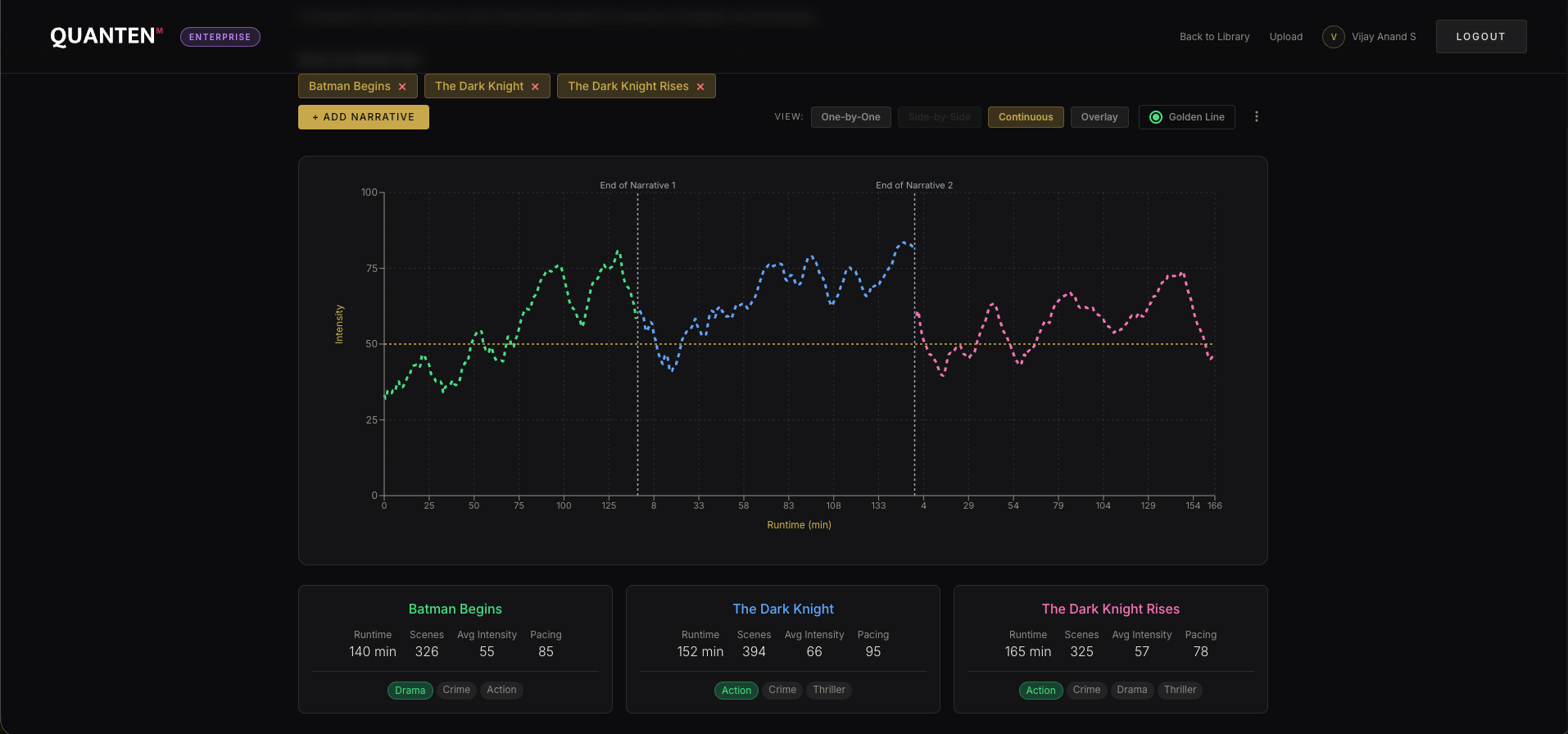
What Stands out:
Batman Begins (green) builds upward from a lower base. The intensity starts in the 30 - 40 range and steadily climbs into the 70s. It’s a clear ramp, prioritizing progression over consistency.
The Dark Knight (blue) operates at a higher baseline. The average intensity sits around the mid-60s, with sustained stretches between 60–80 and fewer prolonged dips. It’s not just higher, it’s more consistent.
The Dark Knight Rises (pink) pulls back slightly. The average drops to the high-50s, with more noticeable fluctuations and several dips below the 50 line. It still hits strong peaks, but doesn’t sustain them as tightly.
The pattern shifts: build, optimize, then release.
Film 1 ramps up. Film 2 locks into a high, controlled intensity. Film 3 loosens that control, trading consistency for variation while closing the arc.
Compare this to trilogies that fail:
The Matrix Reloaded tried to outdo the first film with bigger set pieces and more complexity. By the time Revolutions came around, there was nowhere left to go.
The Hobbit trilogy started overstuffed. By the third film, audiences were tired.
The mistake most trilogies make: peaking too early.
If film 1 is your highest-intensity entry, films 2 and 3 either have to match it (exhausting) or fall short (disappointing). The Dark Knight trilogy avoided this by building gradually.
Successful trilogies understand this:
Lord of the Rings escalated from Fellowship → Two Towers → Return of the King
Toy Story built emotional intensity across all three films
The Bourne trilogy increased stakes methodically
Failed trilogies often peak in film 1:
Pirates of the Caribbean (Curse of the Black Pearl was the high point)
The Hangover (first film peaked, sequels tried to replicate)
Jurassic World (first film had the spectacle, sequels felt repetitive)
Trilogies that work earn their escalation. They don't start at the top.
PS: I was still amazed at the intensity of Batman Begins. It is perhaps the only film that I've seen where the intensity just doesnt let go and man, that's a rollercoaster. And looking back, makes perfect sense.
PPS: That line in the middle, thats the line that separates an audience from casually second screen watching, and holding your seat and hanging onto every shot and frame of the movie.