The Shapes of Founder Stories

Every founder story is the same. That's the problem.
I've sat through enough pitch days to know the shape before the founder opens their mouth. There's a problem in the world. They saw it. Nobody else was solving it. So they built something. Now they're here.
It's not a bad story. It's just not a story. It's a job description.
What's missing isn't detail. Most founders have plenty of that. What's missing is structure. The kind that makes a story feel like it was always going to end this way, even when it almost didn't.
At Quanten Media, we built the Narrative Raagas Framework to analyse story structure in film scripts. We've mapped 459 films against it. What we didn't expect was how cleanly it mapped onto founder stories too.
So we tried it. And found something worth sharing.
What actually drives a founder story
Before a story can have a shape, it needs a starting note. In music, this is the graha, the opening tone that sets everything in motion. In a founder story, it's the thing that made not starting impossible.
We found five.
Crisis. Something in the world was broken and it bothered them enough to act. Not personally, systemically. The drive is external and urgent. The founder didn't choose this so much as get chosen by it.
Pursuit. They wanted to build a different world. Not because something was broken but because something better was possible. The drive is forward-looking. There's an almost wilful optimism to this starting note. The world doesn't have to be on fire for this person to act.
Revelation. They saw something others hadn't seen yet. An insight, a pattern, a truth that felt obvious once you could see it and invisible until you could. The drive is perceptual. The world was always this way. They just noticed.
Discovery. A research outcome, an invention, a technology breakthrough made something previously impossible suddenly viable. This is different from Revelation. The Revelation founder noticed something. The Discovery founder produced something. The insight didn't exist until the work generated it. Most deep tech companies, most university spinouts, most biotech founders start here. And there's something distinctive about this starting note: the founder is often initially reluctant. They were doing research, not planning a company. The discovery arrived and asked something of them they hadn't agreed to yet.
Incitement. Something happened to them. A rejection, a failure, a moment of being told no or being pushed out or watching something they cared about collapse. The wound became the company. The drive is personal. This is the starting note that produces the most visceral stories and the most cautious investors, in equal measure.
Most founders can identify their starting note without much difficulty. What they struggle to articulate is what happened next.
The shape of what happened next
This is where stories diverge. And where most storytelling advice falls short, because it treats setbacks as optional colour rather than structural events.
In the Narrative Raagas Framework, the trajectory of a story is called the pakad. It's the characteristic movement pattern. Not what happened, but how the story moved through what happened.
There are five we see consistently in founder stories.
Progressive. The story moved forward without major reversals. No near-death experience to point to. No pivot. Just accumulation. This is the shape of the overnight success that took fifteen years. The tension isn't what happened. It's why they kept going when nothing dramatic was happening. Bootstrappers who never took outside money often live here. So do founders who are quietly enormous and somehow still unknown. The Progressive story is the most underrepresented in media, because everyone wants drama and this shape has almost none. The drama, if you can call it that, is endurance.
Consolidating. The story advanced in chapters. Each phase had to be fully locked before the next one opened. You can't skip levels. This is the shape of the company that earns its way through every stage. The story has a staircase quality. Unhurried but inevitable in hindsight. Mailchimp is this shape. So is Basecamp. The founder didn't raise a Series A to skip levels. They stayed on each step until it held their weight.
Returning. The story looped back. The original problem, or the original wound, came back harder mid-journey. The founder had to fight the same battle twice. Not a pivot. A recurrence. The second time through they had something they didn't have the first time. The power of this story is in showing what changed between the two attempts. If nothing changed, it's not a Return. It's just failure followed by success, which is a different shape entirely.
Rebounding. The story touched failure and bounced off it quickly. Not a loop, not a dwelling. Contact with resistance, then a change of angle, then forward motion again. The founder processed setbacks fast and kept moving. The story has an elastic quality. What looks like resilience from the outside is often just a very short processing time. These founders are sometimes misread as lucky. They're not. They're fast.
Breaking. The story accumulated pressure along one path long enough that when the break came, it was structural. The new company that emerged was qualitatively different from what they set out to build. The original mission didn't pivot. It ended. Something unrelated survived. Slack is this shape. Stewart Butterfield wasn't iterating on a game. The game died and something completely unrelated was found in the wreckage. The Breaking story is the one most founders are afraid to tell honestly, because it requires admitting that what they set out to do didn't work. The ones who tell it well make that admission the most compelling part.
Twenty-five shapes, not one
Five starting notes. Five trajectories. That's twenty-five structurally distinct founder stories. All of them end in the same place: something got built, it worked, the world is different. But the shape of getting there is different in each case.
The missionary (Pursuit, Progressive) had a vision and the world came around. The prophet (Revelation, Progressive) saw it early and proved right. The accidental founder (Pursuit, Breaking) pursued one thing long enough to discover something more important. The twice-wounded (Incitement, Returning) had the wound that started it reopen mid-journey and had to survive it again to finish. The reluctant founder (Discovery, Breaking) spent years on one application of their research before realising the real value was somewhere else entirely.
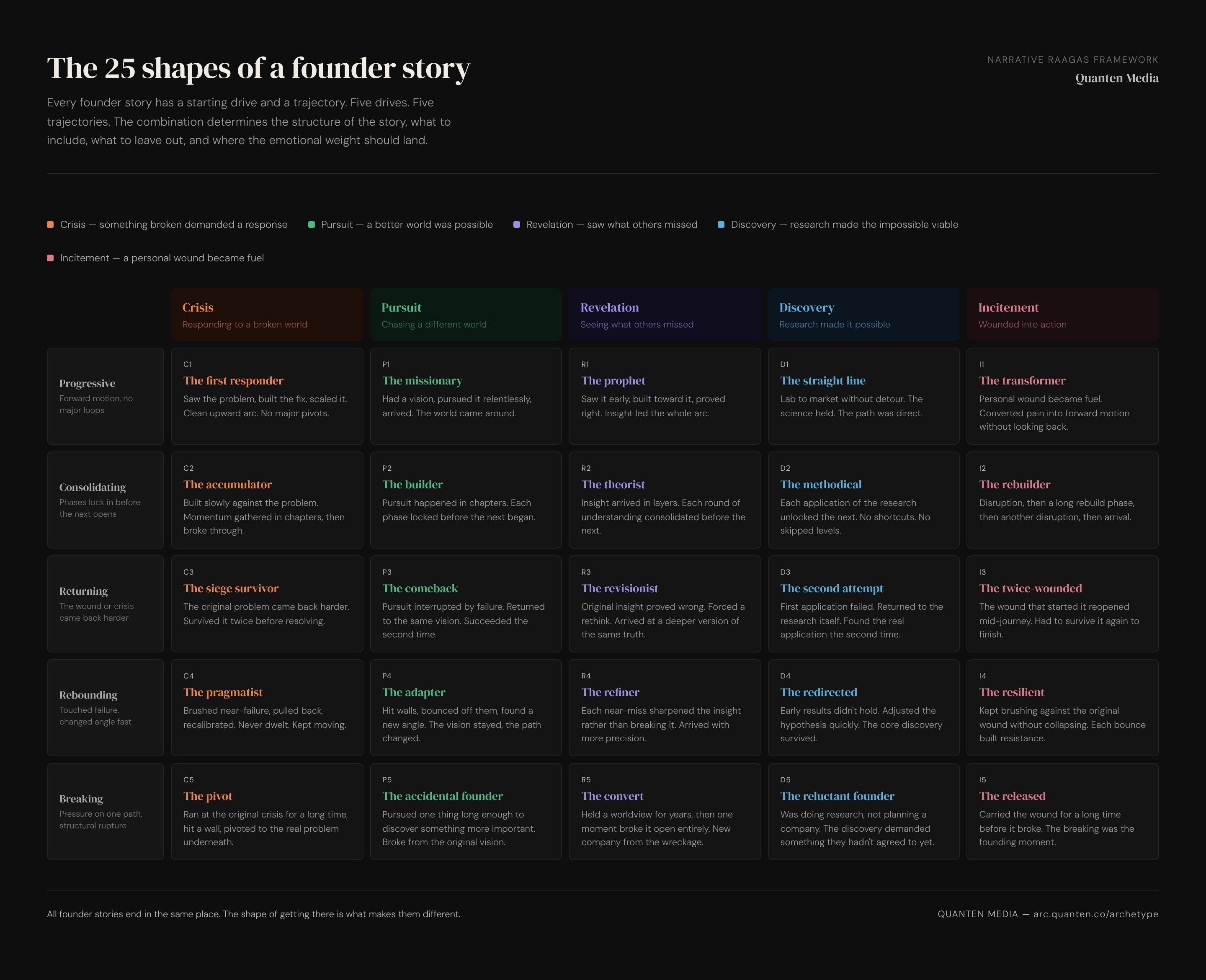
These aren't personality types. They're structural shapes. The same founder could tell a Breaking story about one company and a Consolidating story about the next.
Why this matters for how you tell it
Most founder story coaching focuses on content. What happened, when, to whom. The Narrative Raagas Framework suggests the more important question is shape. What kind of story is this structurally? Because the shape determines what to include, what to leave out, and where the emotional weight should land.
A Progressive story doesn't need a near-death experience. Forcing one in because you think the audience expects it breaks the structure. The power of that story is the quiet accumulation. Let it be quiet. The investor or accelerator partner who recognises that shape will find it more credible, not less, precisely because you didn't manufacture drama.
A Breaking story needs to honour the original mission before it shows the rupture. If you skip the first act, the break has no weight. The audience needs to believe in what was lost before they can understand what was found.
A Returning story needs to show what changed between the first time and the second. The difference is the story. Without it, you're asking the audience to believe you succeeded eventually, which is not the same as showing them why.
A Discovery story needs to make the reluctance visible. The most honest version of that story usually begins not with ambition but with obligation. Something was found. Someone had to do something about it. That tension, between the researcher who wanted to keep researching and the founder the discovery required them to become, is where the emotional weight of that story lives.
An Incitement story needs to be careful about proportion. The wound explains the starting point. It shouldn't explain everything. The most powerful version of this story is one where the founder grew past the wound rather than one where the wound is still running everything. The audience can feel the difference.
One last thing
The story you have is the one worth telling. Not a borrowed shape. Not the one you think investors want to hear. Not the dramatic version of a story that was actually quiet and long.
The Narrative Raagas Framework doesn't tell you what story to tell. It helps you find the structure of the one you already have. Once you know what shape it is, the rest gets easier. You know what to keep, what to cut, and where the weight belongs.
Most founder stories fail not because they're uninteresting but because they're told in the wrong shape. A Consolidating story told like a Breaking story feels dishonest. A Progressive story told like a Returning story invents drama that wasn't there and loses the thing that was.
Find your shape. Tell that one.
The Narrative Raagas Framework is developed by Quanten Media. It is used in Quanten Arc, a narrative structure analysis platform for film and television. Learn more at arc.quanten.co/archetype.