Screenplay Analysis : Obsession
Bear wishes for love. It works. That's the problem. Obsession has sharp dialogue, a clean premise, and it works. The bones are right. The problem is one layer deeper.
Methodology:
Reading a script well means reading it in the right order.
Most script notes start at the surface. The dialogue feels on the nose. A scene runs too long. A character's motivation goes fuzzy in Act 2. These are real observations. But they're almost always symptoms of something deeper – and rewriting the symptom rarely fixes the cause.
The framework we use breaks every script down into four layers, read from the inside out.
L1 is Structure. The bones. What kind of story is this, and are the bones in the right alignment? Before anything else, a script needs a structural contract with its audience -- a promise about what kind of experience is coming, and a form that can deliver it. A misaligned L1 means everything built on top of it is unstable, no matter how well written.
L2 is Characters. The people who inhabit the structure. Do they have clear goals, genuine motivations, and specific flaws that put them in conflict with what they want? A structurally sound story with passive or underdeveloped characters stalls -- not because the plot is broken, but because no one is driving it.
L3 is Dynamics. How the characters interact with each other. Where their arcs intersect, create friction, generate consequence. This is the layer most writers think of as "the story." And it is – but it only holds when L1 and L2 are sound beneath it.
L4 is Dialogue. The surface. Scenes, exchanges, texture, voice. This is where almost every development conversation begins. It's also the last place to look for the root of a problem.
The hierarchy is the point. You can't fix L3 if L2 is broken. You can't fix L2 if L1 is misaligned. A note at L4 that should have been a note at L2 doesn't just fail to help -- it sends the writer in the wrong direction.
Reading a script through these four layers, in order, changes what you see and where you look.
The Script: Obsession by Curry Barker
Obsession is a horror romance. Bear, a 25-year-old with a dead cat and a long-unrequited love for his friend Nicky, makes a wish on a mysterious artifact called the One Wish Willow. He wishes that Nicky loved him more than anyone in the world. The wish works. What follows is not what he wanted.
It's a smart premise. Monkey's paw horror with a romantic core. The kind of script that could go several ways depending on how the layers below the premise are built.
Let's go through them.
L1: Structure
The structural contract this script makes with the audience is a horror romance – specifically, the "monkey's paw" variant. A man makes a wish. The wish comes true in the worst possible way. The story is about the cost of getting what you want.
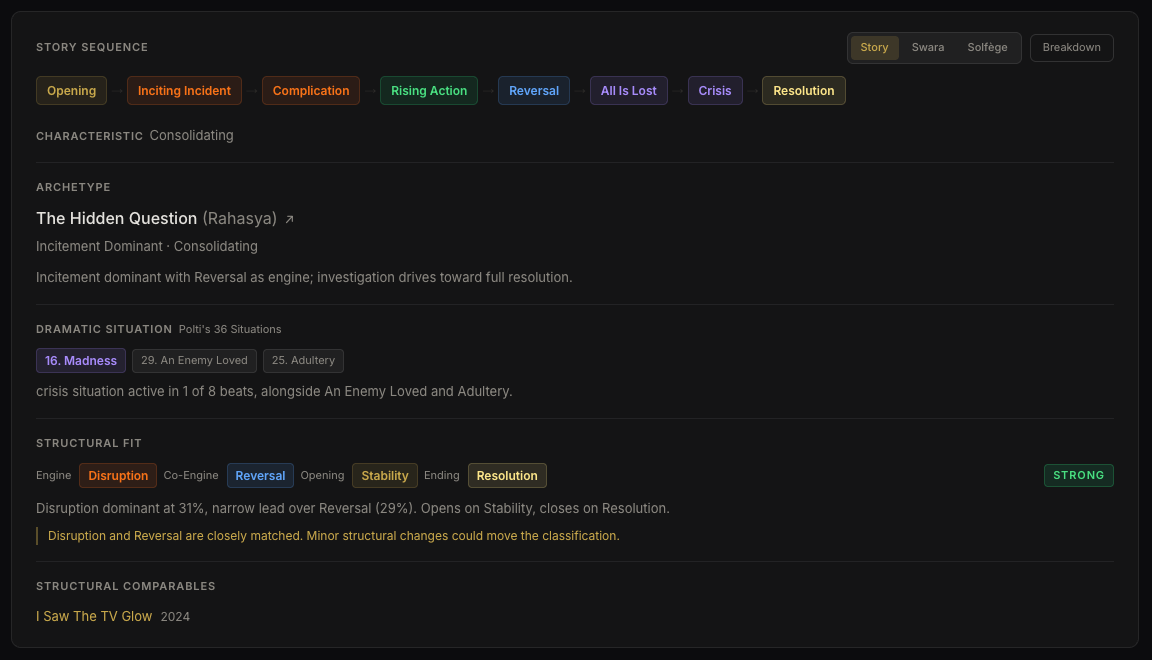
Within the Narrative Raagas framework, Obsession classifies as The Hidden Question (Rahasya) – an Incitement-dominant archetype where Reversal is the engine and investigation drives toward full resolution. The match score is 100%. That classification is precise. The dominant register is Incitement at 31.1% of runtime, with Reversal close behind at 29.2%. The story is structured as a question Bear can't stop asking – what is happening to Nicky, and can it be undone – with each act tightening the answer until there's no way out.
The archetype also explains why the ending works as well as it does. A Hidden Question story resolves when the hidden question is finally answered. Bear's answer arrives in the final pan – a freshly used One Wish Willow on the table. Nicky made her own wish. The investigation closes. The cost is total.
That contract is clean and well established. The One Wish Willow is introduced early, the wish is made at the end of Act 1, and the consequences unfold through Act 2. The escalation is controlled. The tonal balance – romantic comedy underneath, horror growing on top – is ambitious but the script manages it more often than it doesn't. The dinner date scene, where Bear and Nicky are genuinely tender with each other while Bear knows exactly what he's responsible for, is the best expression of that balance.
The structural problem is not the archetype fit. It's the weight distribution within it. The Complication beat runs 31% of runtime across 11 scenes, and the pacing data flags Act 2 as the drag point. For a Hidden Question archetype to sustain, the incitement engine needs to keep generating new questions. When it idles – which the montage sequences and repetitive escalation scenes in Act 2 allow it to do – the forward momentum stalls.
Structure (L1): 7/10
L2: Characters
This is where the script's central problem lives.
Bear is introduced beautifully. Dead cat on the living room floor. Pills collected and put away. A romantic film on TV. This is a man who wants love, won't act on it, and is at least partially aware of both. That's a rich, specific character foundation.
The problem is that foundation never activates. Bear's goal is Nicky. His flaw is passivity. But the story never puts these two things in real tension -- never gives him a moment where his passivity is tested, where he has to choose between action and avoidance and lives with the consequence of that choice. The wish itself is passive: half-joking, alone in a car outside Nicky's house at midnight. He doesn't even believe it's real.
When a protagonist never drives an act transition, the story has to be carried by other forces. In Obsession, that force is Nicky.
And Nicky is genuinely well constructed. Pre-wish Nicky is established with real specificity – her philosophy on love versus romance, her novel, her frustration at work, the crystal necklace down the drain. This is a person. Post-wish Nicky is frightening precisely because those qualities survive in distorted form. She still talks about love with the same vocabulary. She still cares about Bear's dead cat. The wish didn't build a monster from nothing. It amplified something that was already there and removed the regulator. That's a much more interesting horror idea than simple possession, and the script earns it.
The bedroom scene where the real Nicky surfaces – "Kill me, Bear. Please." – is the script's most important character moment. Two versions of the same person in direct conflict, the real one begging for release. Bear walks out. That single moment contains the entire moral weight of the story. The script needed more scenes like it.
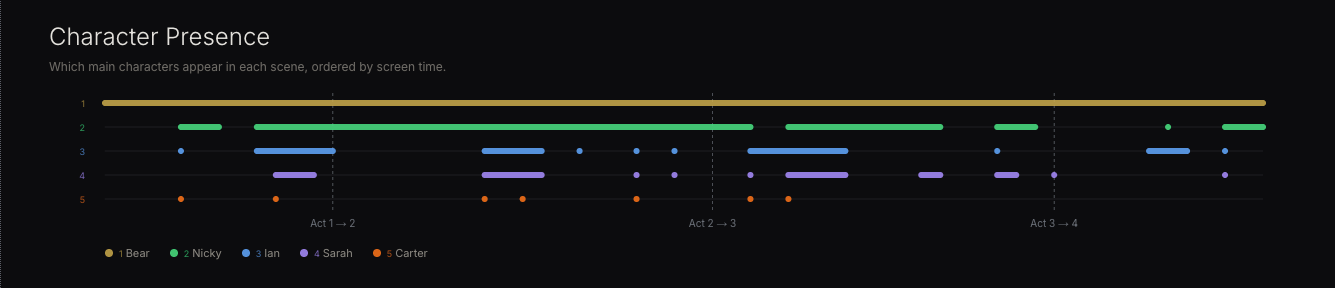
Ian functions well as Bear's warning system and works in Act 1 and early Act 2. His death is the most structurally wasteful moment in the script – cut loose offhandedly, mid-scene, with no ceremony. He deserved better. So did the story.
Sarah is the script's most underdeveloped major character. She's given specific texture – the bass clef tattoo, the art school rejections, the Luther letter – but she never drives action. She exists to observe, to warn, and ultimately to be killed. Her death is intended to be the horror that breaks the film open. It doesn't land with the weight it needs, because we haven't been given enough reason to grieve her specifically.
Characters (L2): 6.5/10
L3: Dynamics
L3 is two things at once: how the characters interact with each other, and how the story builds. The relationship threads and the intensity arc are the same layer read two different ways. When they're working together, the story accelerates. When they're not, the script flatlines regardless of what's happening on the surface.
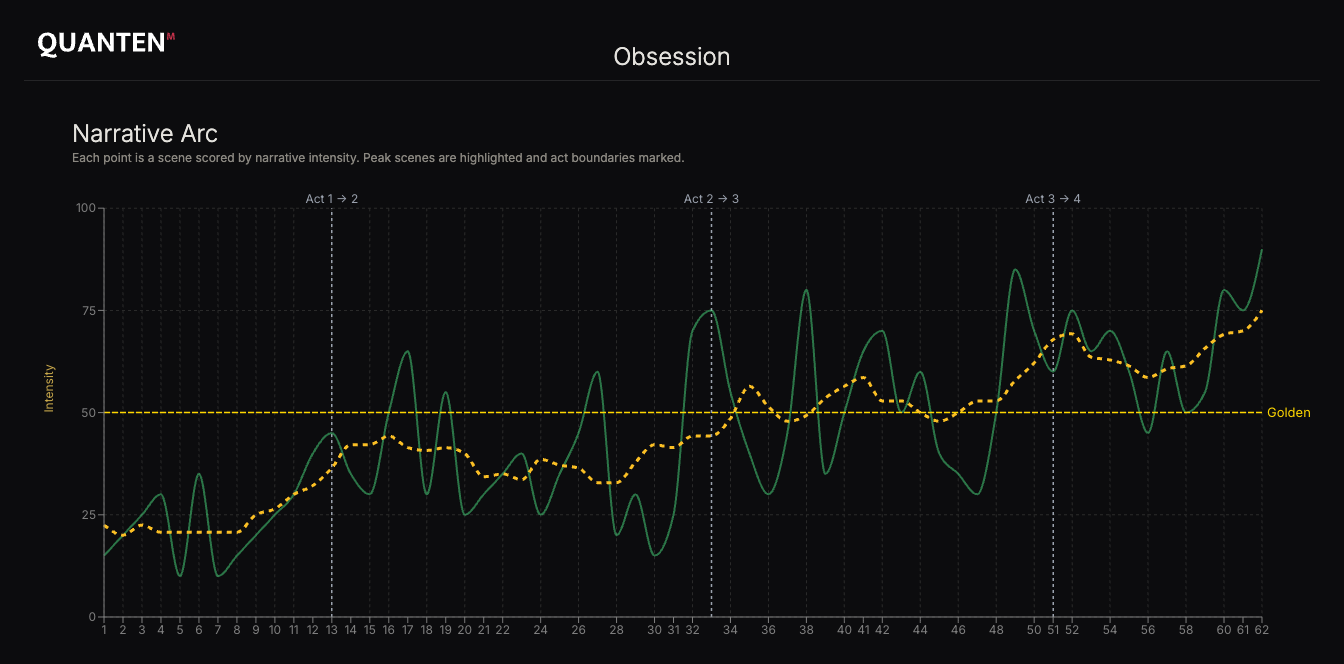
The smoothed intensity arc for Obsession tells an honest story about where the script is working and where it isn't.
Act 1 (scenes 1-13) is a clean ramp. Intensity starts low in the 20-22 range – Bear on his couch, the dead cat, the crystal shop – and builds steadily to 36 by the wish scene. The setup earns its time. The audience is being given the world they're about to lose.
Act 2 (scenes 14-33) is the problem. Intensity jumps to 42 immediately after the wish, then plateaus. For twenty scenes – nearly a third of the screenplay – the smoothed arc sits in the 33-44 range without meaningful escalation. The pacing verdict calls it correctly: repetitive scenes of Nicky's erratic behaviour and Bear's passive confusion. The intensity isn't building because the relationships aren't generating new friction. Every scene in this band is a variation on the same dynamic. Nicky escalates. Bear absorbs. Nothing changes the equation.
Act 3 (scenes 34-51) is where the script finally finds its engine. The arc climbs from 48 to 68 across eighteen scenes – the steepest sustained rise in the film. This is where the horror becomes real rather than unsettling. The party scene, the hospital refusal, the shrine, the confrontation. The relationship threads are finally colliding rather than running parallel.
Act 4 (scenes 52-62) holds in the 63-75 range and closes at 75. It sustains rather than peaks and releases, which is consistent with a Hidden Question archetype -- the resolution is the answer, not the explosion. But 75 is a low ceiling for a film that involves murder, a shrine built from a dead woman's body, a gun, and a double death. The compressed intensity range means the horror registers as sustained dread rather than shock. That's a legitimate tonal choice. It also means the final act feels like a slow arrival rather than an earned detonation.
On the relationship threads specifically: three are set up, and they don't pull with equal force.
Bear and Nicky carries the script. The car conversation where Nicky distinguishes between romance and love is the script's best scene – two people slightly more revealed than they intended to be. That's the relationship the audience needs to believe in and grieve for. When the script returns to that register in Act 3 – the dinner, the brief tender moments between eruptions – the horror of what Bear has done becomes real. The problem is that the two threads (Bear's guilt, Nicky's obsession) run parallel through most of Act 2 without colliding. They share scenes but they're experiencing different films. That's the Act 2 plateau in the arc.
Bear and Ian is the most functional secondary thread. The Act 1 car scene – Bear rehearsing his confession while Ian dismantles it – is sharp and does real character work. Ian's warnings in Act 2 are specific and credible. The friendship feels real. Which makes Ian's offhand death the most wasteful single moment in the script. A functioning thread, cut without consequence.
Bear, Nicky and Sarah is the thread that never fires. The triangle has everything it needs – Sarah's feelings for Bear, Nicky's awareness of them, the escalating danger – and generates almost no dramatic friction. Sarah and Nicky share almost no direct scenes. The confrontation this triangle is building toward never happens, because Nicky eliminates Sarah before it can. That unused friction is exactly what the Act 2 plateau needed.
The Ian-Nicky history – two years of hooking up, recently ended – lands as a deathbed revelation. It should have been Act 2 fuel. Seeded early, it recontextualises every scene Nicky is in and gives the plateau something to burn.
Dynamics (L3): 5.5/10
L4: Dialogue
This is the script's clearest strength, and the gap between L4 and L3 tells you something about how the writer works.
The pre-wish dialogue is naturalistic and specific in a way that's genuinely hard to do. The mallet customer story, the trivia bar banter, the Three Bite Bailey dinner scene, Ian's "I wake up every Wednesday rock-hard thinking about trivia night" – this is a writer who can hear how people actually talk to each other. The friendship between these four people is established through dialogue alone, and it's convincing.
Post-wish dialogue is deliberately fractured and it's mostly effective. Nicky's mid-scene register shifts work because they're so precisely wrong – not generic crazy-person wrong, but specifically, disturbingly wrong in ways that echo who she was before. "Hi, I'm Normal" is the most formally strange line in the script. It works because it's so exact.
The script's best single line is quiet: "I've never been with you, Bear." Four words from the real Nicky, in a dark bedroom, while the other version of her sleeps. The whole film is in that line.
The final confrontation sequence – the screaming, the gun, the vomiting, "SCREAM IT" – is where the script overextends. The horror up to this point has been most effective when it's intimate and still. This sequence tips into Grand Guignol, which is a different register entirely. The excess may be intentional. It still diffuses the tension rather than concentrating it.
Bear's tendency to explain himself in dialogue is the most consistent L4 liability. When he can't act, he talks – to Ian on the phone, to himself in the car, to the bathroom mirror. These monologues expose the L2 problem rather than compensating for it. Dialogue that explains what action should be showing is a symptom, not a solution.
Dialogue (L4): 7.5/10
What This Tells Us
| Layer | Label | Score |
|---|---|---|
| L1 | Structure | 7.0 |
| L2 | Characters | 6.5 |
| L3 | Dynamics | 5.5 |
| L4 | Dialogue | 7.5 |
The gap between L4 and L3 is the diagnostic. This writer can write. The dialogue is good. The premise is good. The archetype fit is exact. But the relationship dynamics – the layer where character motivations should be colliding and generating friction – are underbuilt. Three threads that should be pulling against each other are mostly running in parallel.
And that L3 gap is caused by the L2 problem. Bear's passivity means he never generates friction. He absorbs it. The characters around him have to supply all the dramatic energy – Nicky through escalating horror, Ian through warnings, Sarah through signals Bear chooses not to read. When you have a passive protagonist, your L3 dynamics flatten, because dynamics require two forces pushing against each other.
The fix isn't in the dialogue. The fix isn't even in the dynamics. The fix is in Bear. Give him one clear, active, irreversible decision early in Act 2 – made with full awareness, not under duress – and everything built on top of it holds differently.
That's the development note. One note. At L2. Everything else is already there.
You can see the full analysis for Obsession on Quanten Arc here
PS: A score of 7.5/10 is good. 8/10 is extremely good.
Development Notes
Here's the thing about L2 and L3. They're not independent problems. L3 is weak because L2 is weak. Fix L2 correctly and L3 partially repairs itself without a single additional scene being written.
So the development conversation is really one note, not two.
The L2 note:
Bear needs one active, irreversible decision in Act 2 – made with full awareness, not under duress, not as a reaction to Nicky's escalation. Something that commits him to a direction and has consequences he has to live with. Right now every move Bear makes is defensive. He responds, absorbs, avoids. Give him one moment where he chooses, and the protagonist becomes someone the audience is watching rather than watching things happen to.
That one change does four things simultaneously:
It activates Bear's arc. It creates a genuine turning point in Act 2. It gives the Ian-Nicky history something to land on if revealed earlier. And it gives the Sarah-Nicky-Bear triangle a charge, because Bear having made an active choice means there's something at stake in how the other relationships read it.
What that does to L3:
The Act 2 plateau in the intensity arc – that 33-44 flatline across twenty scenes – exists because the relationship threads have nothing new to combust. Bear absorbing Nicky is the same scene on a loop. One active Bear decision creates asymmetry. Asymmetry creates friction. Friction drives the arc upward.
The Ian-Nicky history revealed earlier is the second lever. That information, seeded into Act 2, recontextualises every scene Nicky is in and gives Bear something to know that changes how he reads the situation. Right now he's confused. Confusion is passive. Give him information and he has to decide what to do with it.
Realistic target:
With those two interventions – Bear's active decision, Ian-Nicky history moved earlier – L2 moves from 6.5 to a credible 7.5. L3 follows, probably from 5.5 to 7. The intensity arc in Act 2 fills in, the plateau breaks, and the script's existing L4 strength finally has the structural and character foundation it deserves underneath it.
The script is closer than the scores suggest.
PS : This analysis is based off of a script dated 03-09-2024. The final version of the film might have slight variations.
Note : While structurally having Bear make atleast one decision to own up to his role would be a good thing, leaving him to be dragged along in the story, never having the courage of step up to what he needs, wants or in doing the right thing also leaves a sense of dissatisfaction with the audiences that leaves them talking about it, which might work in the favor of the movie. So creatively was the best thing to do.