Screenplay Analysis : Backrooms
Crisis Dominant siege, correct archetype match. Strong kitchen centrepiece. Three fixable issues: Act 3 sags, Clark's deterioration is off-page, Mary's threshold motivation is underwritten. Strong first draft.
The analysis is read on four levels - the structure, the characters, the dynamics and the dialogue - represented from L1 to L4.
L1: STRUCTURE
Archetype: The Siege [Dhairya] | Crisis Dominant | 100% match
The Siege archetype sits correctly. The film opens at the apex of crisis (James trapped in the Backrooms, Sc. 1-2), descends into an ordinary world that has already been fractured (Clark's failed life, Sc. 3-22), and never fully leaves crisis register. Crisis dominates at 46.4%, which is correct for this material. The structure is not a descent into horror - it's a story told from inside one.
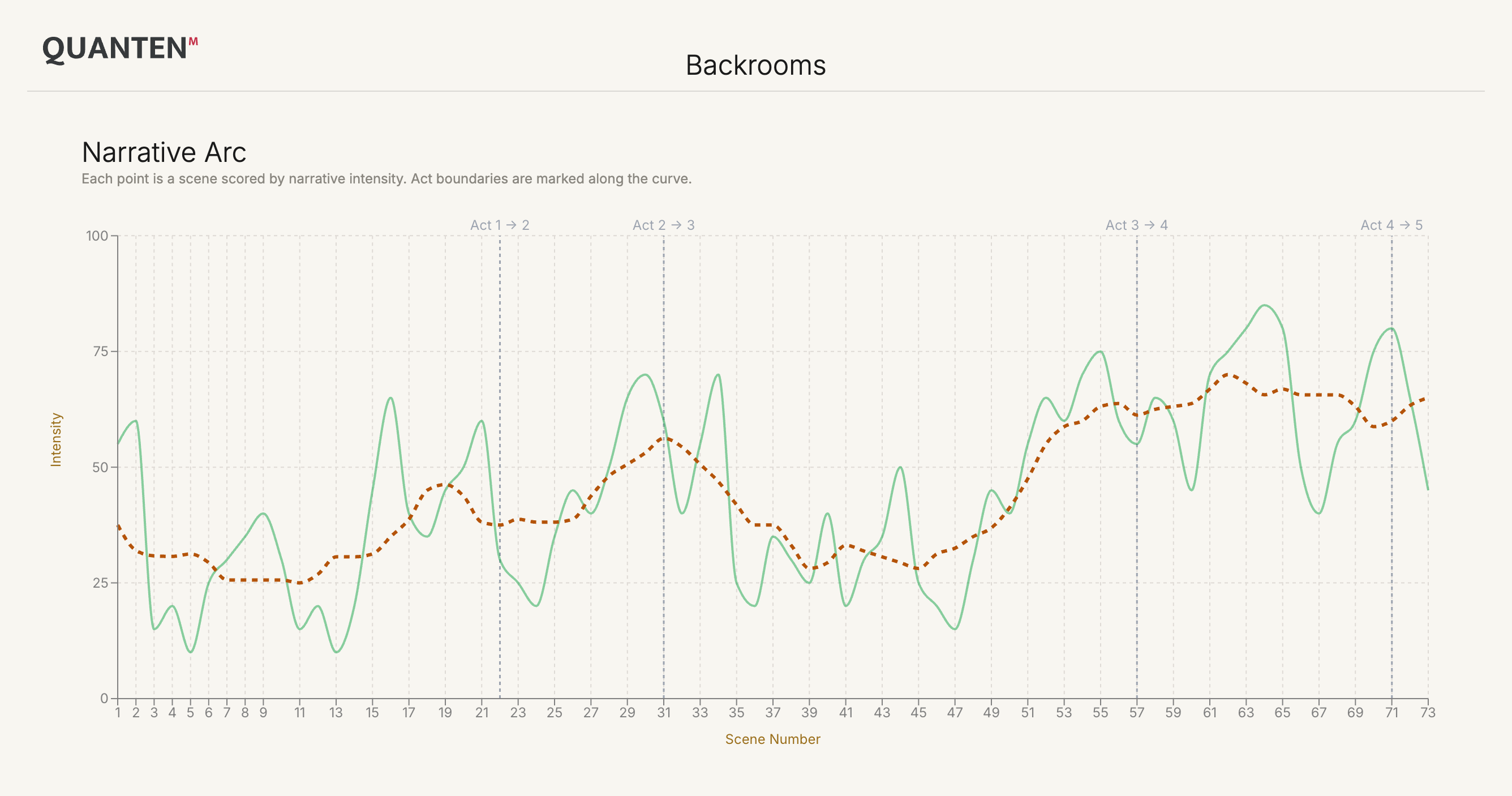
5-Act Structure — Performance by Act
| Act | Scenes | Duration | Arc behaviour | Verdict |
|---|---|---|---|---|
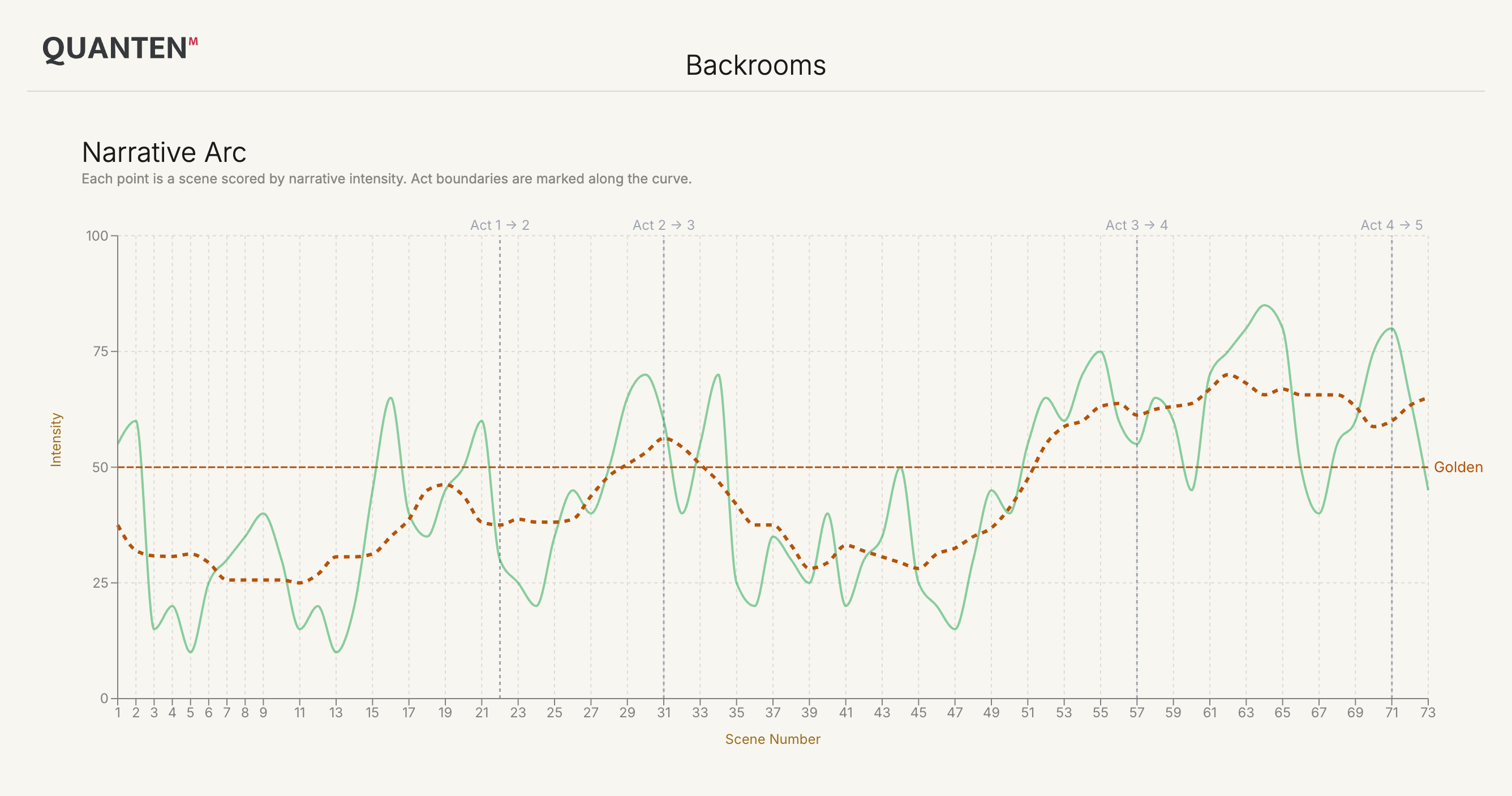
| 1 | 1-22 | ~35 min | Opens at 55, drops to 10, climbs to 65 (Sc. 16), retreats to 30 | Strong. Discovery beat (Sc. 15-16) well-earned. Long setup risks audience dropout around Sc. 5-13 (10-20 range) |
| 2 | 23-31 | ~15 min | Rises from 25 to 70 (Sc. 30), peak | Best-structured act. Clear purpose, strongest scene in first half (Sc. 28, Bobby sequence) |
| 3 | 32-57 | ~30 min | Opens at 70 (Sc. 34), drops hard to 20, rebuilds to 75 (Sc. 55) | Structural sag from Sc. 35-48. The Async investigation runs long at low intensity. Recovers well at Sc. 53-55 |
| 4 | 58-71 | ~18 min | Holds 60-85, multi-peak cluster | Effective. Peak density works. Minor plateau Sc. 67-69 is the one soft zone |
| 5 | 72-73 | ~2 min | Drops to 65, ends at 45 | Correct tonal register for an ambiguous close. Under-dramatised but intentionally so |
Structural Health Observations
The script uses a 5-act structure where Acts 1 and 2 belong to Clark, and Acts 3-5 belong to Mary, with Clark reappearing as antagonist. This protagonist hand-off is the primary structural risk. Act 3 performs the most complex work: introducing Mary, building her backstory (childhood Victorian sequence, Sc. 32-33, 51-52), establishing the Async conspiracy, and pivoting her into the Backrooms. That is too much for 30 minutes at consistently low intensity scores (Sc. 35-48 averages ~25-30).
Beat Map
| Beat | Scenes | Swara | Label | % Runtime |
|---|---|---|---|---|
| 1 | 1-2 | Pa | Crisis open | 5.3% |
| 2 | 3-5 | Sa | Interlude / ordinary world | 4.4% |
| 3 | 6-20 | Ga | Rising Action (Clark) | 19.7% |
| 4 | 21-27 | Ga | Rising Action continues | 14.3% |
| 5 | 28-33 | Pa | All Is Lost (Bobby killed) | 11.1% |
| 6 | 34-48 | Ri | Inciting Incident (Mary thread) | 11.3% |
| 7 | 49-69 | Pa | All Is Lost (Mary's siege) | 29.9% |
| 8 | 70-73 | Ni | Climax and close | 3.9% |
The Crisis register accounting for 46.4% total is structurally consistent, but Beat 7 at 29.9% is very long for a single All Is Lost register. It contains two distinct sub-movements (Mary captured, Mary chasing/escaping) which the beat map does not differentiate. This is worth revisiting at the analysis layer.
L2: CHARACTERS
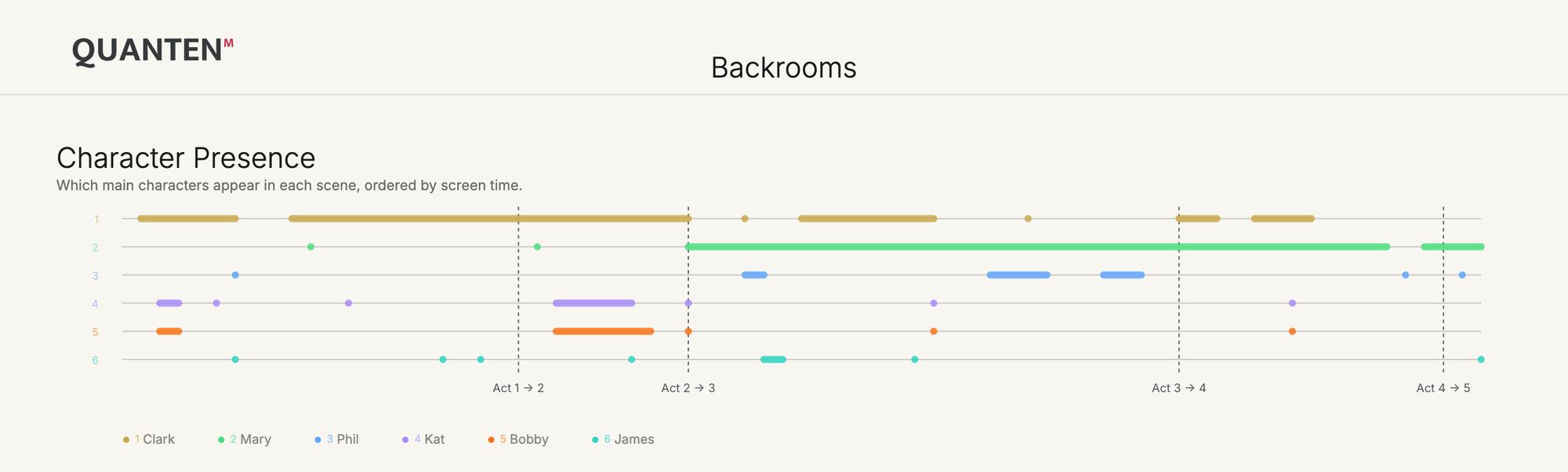
Clark (Chiwetel Ejiofor) - 45 scenes
The most complete character in the script. His arc is fully drawn: failed architect, failed marriage, alcoholic self-isolator. Mary's therapeutic device - the "new path" metaphor - sets up his Backrooms obsession structurally and thematically. By Act 4 he has become a Still Life of himself: feeding on the synthetic, repeating the script of his marriage, consuming what cannot feel pain. The regression is earned. His final line "Help... me..." - mirroring the entity's mimicry of his own voice - is the script's strongest thematic closure for this character.
Weakness: Clark's transition from curious explorer (Acts 1-2) to dissociated predator (Act 4) has a gap. The time dilation that explains his ageing is implicit, not dramatised. The script tells us he's been there a long time through appearance alone. A single scene of Clark trying to return and failing would bridge this.
Mary (Renate Reinsve) - 44 scenes
Mary is the more structurally important protagonist but the less developed character in Acts 1-2. She appears primarily as Clark's mirror - warm, perceptive, grounded — before her own story takes over in Act 3. Her childhood trauma (Julie's death, Sc. 32-33, 51-52) is the emotional spine, and the catharsis in Sc. 63 - "I can't save anyone" - is the thematic pivot of the whole film. That's a strong character beat. However, her motivation for entering the Backrooms (Sc. 58) relies on circumstantial pressure (discovery of James's ID, Phil's betrayal) rather than an internal need specific to her character. The connection between her survivor's guilt and her decision to cross the threshold is present but underwritten.
Phil (Mark Duplass) - 12 scenes
Functions primarily as a structural reveal mechanism. His complicity in the Async conspiracy is withheld correctly (Sc. 35, 50 are well-handled misdirects). The final betrayal (Sc. 72) lands because of the relationship texture built in Sc. 34. However, Phil has no interiority the audience is allowed access to. His "I'd never let that happen" followed immediately by the syringe is effective irony, but he remains a plot function rather than a character.
Bobby/Kat - 11/12 scenes
Bobby's death (Sc. 28) is the script's most visceral sequence and the correct structural cost to establish the Entity's lethality. Kat survives longer in the Backrooms (implied by the fridge reveal, Sc. 63) but her fate is disclosed as dark comedy rather than drama. This is a deliberate tonal choice, though it flattens what could have been a second emotional cost.
James Kittredge (Avan Jogia) - 8 scenes
Acts as the film's structural bookend. He opens the film (Sc. 1-2, pre-title) and closes it (Sc. 73). His function as a ghost-prior-protagonist who has already lost is well-constructed. His final line - "How can you be sure?" - which echoes Mary's own therapeutic catchphrase, is the script's strongest closing device.
L3 : DYNAMICS
Relationship Architecture
The script's core dynamic is between Clark and Mary as therapist/patient, but it is mirrored at every level:
- Clark/Barbara (absent, referred to) — the original wound
- Clark/Backrooms entity — the forest that tells you where to go
- Mary/Phil — the relationship built on withheld knowledge
- Mary/Julie — the unresolvable debt (the ghost that keeps returning)
- James/Mary — the structural echo (both trapped; one past the point of return)
The "new path" metaphor that Mary uses therapeutically in Act 1 (Sc. 7, 8, 9) is reclaimed by Clark in Act 4 as an inversion — the forest always wins, the path is predetermined. The script plants this device early and uses it consistently, which is a strength.
Tonal Architecture
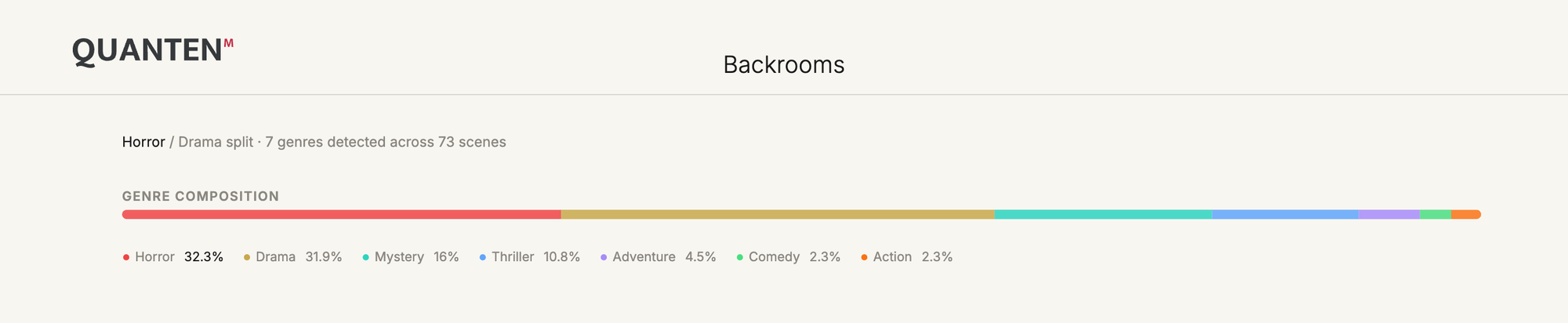
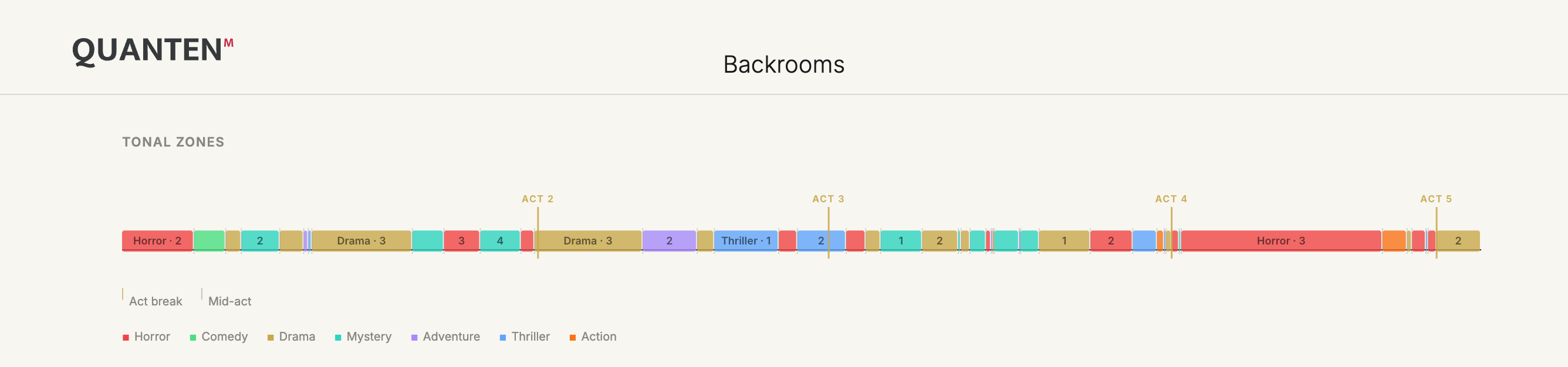
Genre composition: Horror 32.3%, Drama 31.9%, Mystery 16%, Thriller 10.8%.
The near-equal balance of Horror and Drama is the film's most interesting tonal choice and its most significant risk. The script earns it in Act 4 (Sc. 63 runs 476 seconds — nearly 8 minutes — and holds both tonal registers simultaneously). It earns it less well in Act 3, where the Drama register (Sc. 35-50) runs without Horror to give it urgency.
The Comedy register (Sc. 3-4, the pirate furniture ad) is used correctly as an opening tonal misdirect. It works.
Recurring Motifs
Three motifs do structural work throughout:
- "Three birds, seven seconds" — functions as a countdown device (James, Sc. 1), a warning sign (Sc. 20), an exit signal (Sc. 67), and a trap indicator (Sc. 73). Correctly seeded and paid.
- The "new path" / forest metaphor — introduced in therapy (Sc. 7), echoed in voiceover (Sc. 8-9), inverted by Clark in Sc. 63, reclaimed by Mary ("I can't save anyone") in the same scene. Clean structural arc.
- The black umbrella / Little Girl — functions as the Entity's herald. First appearance (Sc. 21), repeated (Sc. 30, 44, 63). Effective horror device. Its final use (Sc. 63, the entity lifting the Little Girl into the ceiling) resolves this thread visually.
Pacing Score: 78 (arc data) / 65 (insights data)
The two pacing scores in the data diverge — 78 and 65. The lower figure better reflects the structural reality. The primary pacing concern is Act 3 Scenes 35-48 (the Async investigation), which sustains intensity in the 15-30 range for approximately 12 minutes. This is the script's most significant pacing problem.
L4 : DIALOGUE
Voice Differentiation
Clark and Mary's voices are distinct and consistently maintained. Clark's dialogue in Acts 1-2 (the pirate persona, the deflections in therapy, the excited salesmanship around the Backrooms) correctly gives way to something clipped and liturgical in Act 4. The shift is audible in the text.
Mary's therapeutic register ("How can you be sure?", "Are you ready to make a new path?") is used as a recurring device with payoff — James's final delivery of "How can you be sure?" in Sc. 73 closes the loop correctly.
Therapy Scene (Sc. 11) — 249 seconds
This is the longest single scene in Act 1 and the most dialogue-dense scene in the script. It functions as both character exposition and mechanism for establishing the thematic frame. The roleplaying device (Clark enacting the fight with Barbara) is a smart piece of screenwriting — it gives Clark active behaviour rather than passive confession. The "fucking architect" explosion is the scene's emotional peak and correctly placed late. The scene earns its runtime.
Sc. 63 — 476 seconds (Kitchen sequence)
The centrepiece scene. The dialogue here carries five simultaneous functions: Clark's psychotic monologue, the roleplay re-enactment of the marriage, Mary's pivot from victim to interrogator, the thematic resolution of the film's central question, and the horror set-up for the Entity's arrival. That is exceptionally ambitious for a single scene. The "I can't save anyone" beat lands. The line "You are your brain, you dipshit" is the film's most direct thematic statement and works because it's delivered under duress. The scene holds together.
Weak dialogue zones
- Sc. 35-36: The party sequence. Phil and the Async employees' conspiratorial dialogue is functional but generic ("you're overreacting," "we all saw the tape"). This is the most exposition-reliant dialogue in the script.
- Sc. 50: The KV31 dinner conversation. Phil's explanation of recursive space works thematically but the "you'd need four years at MIT" deflection is a convenient way to avoid dramatising the actual stakes. It performs as plausible misdirection but thin character work for Phil.
- Sc. 28: Bobby's death sequence. The dialogue under duress ("it hurts it hurts it hurts") is intentionally repetitive and correct for the moment. No issue here — it's doing what it needs to.
KEY STRUCTURAL ISSUES
- Act 3 intensity trough (Sc. 35-48) — 12+ minutes at intensity 15-30. The Async investigation scenes do necessary narrative work but carry almost no dread. The childhood trauma flashbacks (Sc. 32-33) are correctly placed to bookend this section but don't lift the register of the investigation itself. One Horror-register intrusion — a single Backrooms element bleeding into the Async world — would sustain the genre contract through this passage.
- Clark's deterioration gap — The script moves from Clark-as-explorer (Act 2, Sc. 26-31) to Clark-as-predator (Act 4, Sc. 61-63) with no bridge scene. The ageing is shown, not dramatised. A short sequence of Clark attempting to exit and failing — discovering the Backrooms will not release him — would make his Act 4 psychology dramatically legible rather than visually implied.
- Mary's threshold motivation — Her decision to enter the Backrooms (Sc. 58) is motivated by Phil's betrayal and Clark's disappearance, but her personal stake (survivor guilt re: Julie) is not connected to this decision at the script level. The film's thematic resolution ("I can't save anyone") is more powerful if Mary enters the Backrooms precisely because she believes she can save Clark — i.e., if the same pathology that failed Julie is what drives her in. That connection currently exists thematically but not causally.
- Act 5 compression (Sc. 72-73, 2 min) — The final act runs very short relative to the dramatic weight it is asked to carry. Phil's betrayal and James's reveal are both present, but the holding cell scene ends on a title card rather than a beat. The "three birds, seven seconds" countdown in the final image is strong but the smash to black before the resolution of what's coming leaves the scene suspended rather than closed. This may be intentional franchise positioning, but on a standalone read it registers as incomplete.
- Bobby and Kat's fates — Bobby's death is dramatised at full intensity (correct). Kat's fate is revealed as a dark comedy moment in Sc. 63 (the fridge). Given that Kat is the emotional audience-surrogate during the Act 2 Backrooms sequence, disposing of her off-screen as a punchline creates a tonal mismatch. A brief acknowledgement of horror before the comedy beat would rebalance this.
STRUCTURAL COMPARABLES
Archetype matches (The Siege, Horror, English): Alien: Romulus (2024), The Substance (2024), A Quiet Place (2018).
Of these, Alien: Romulus is the closest structural analogue — a known threat space, a protagonist who enters on purpose, a contained escalation. The Substance is the closest tonal analogue — equal parts body horror and psychological drama.
SUMMARY VERDICT
A genuinely ambitious first draft. The structural architecture is sound — the archetype match is correct, the thematic system is coherent, and the centrepiece sequence (Sc. 63) justifies the film's tonal ambition. The primary structural problem is Act 3, which sustains low intensity for too long during a passage that requires the audience to transfer allegiance from Clark to Mary while simultaneously absorbing exposition about Async. The secondary problem is Clark's deterioration gap. Both are fixable at script level without restructuring the film. The final act needs one additional scene. At the character and dialogue level this is already performing at a high standard for a first draft.
This analysis is based on a publicly available draft titled "First Draft" dated 12/01/2024