Deconstructing Sinners: Best Original Screenplay
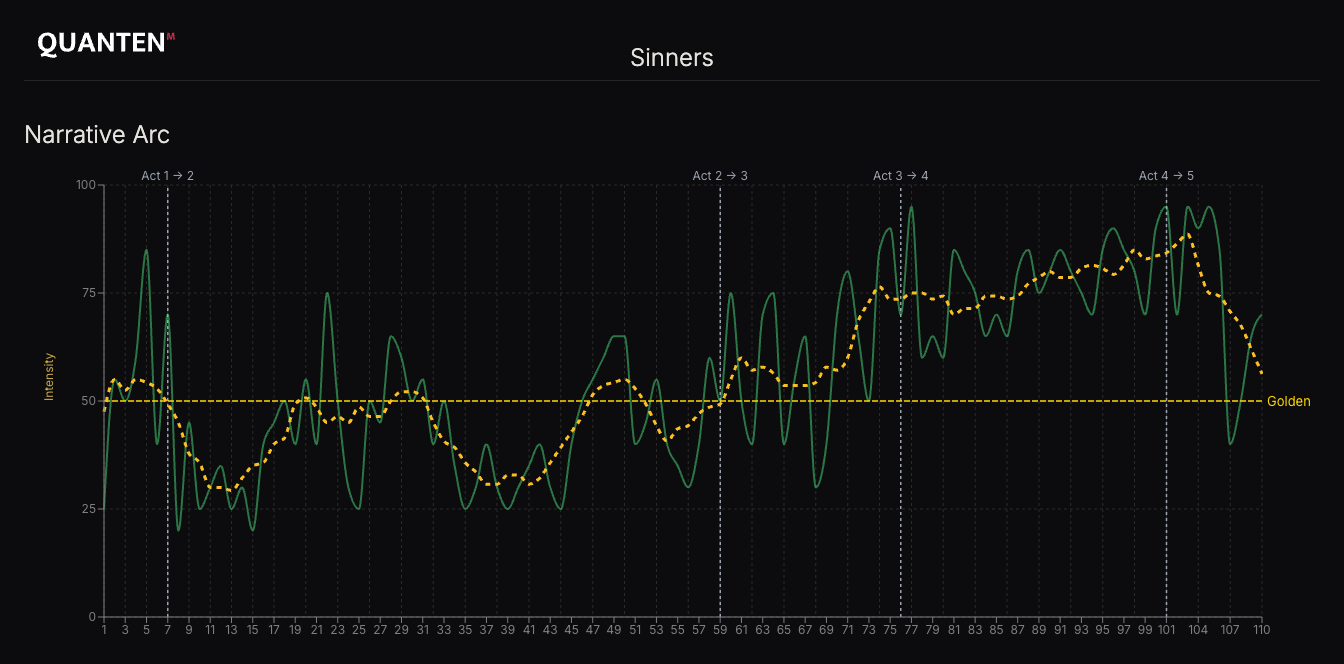
After Sinners took home Best Original Screenplay, we mapped it through Quanten Arc. What the map shows is a script operating on its own internal logic, one that does not conform to the template most development tools are calibrated against. For starters, Sinners is not three acts. It is five.
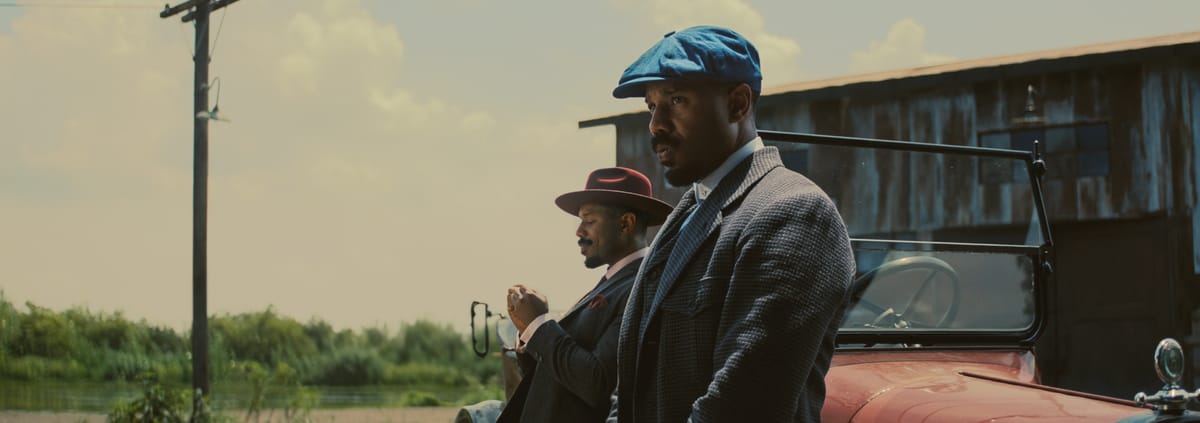
After Sinners for nominated for the Oscars, we mapped it through Quanten Arc, the framework we use to visualize narrative structure scene by scene. What the map shows is a script operating on its own internal logic, one that does not conform to the three-act template most development tools are calibrated against.
That is not a criticism of those tools. It is an observation about what happens when a script is built on a different shape entirely.
For starters, Sinners is not three acts. It is five. The film is structured more like a show, than a typical film.
[You can download the script for Sinners from Script Slug here]
The five-act structure
| Act | Scenes | Function |
|---|---|---|
| Act 1 | 1 to 7 | Prologue: supernatural threat established, no main characters |
| Act 2 | 8 to 59 | New World and Preparation: community building, the juke joint dream |
| Act 3 | 60 to 76 | The Party and False Peak: the juke joint opens, doom gathers |
| Act 4 | 77 to 101 | Descent into Horror and Siege: sustained horror movement |
| Act 5 | 102 to 110 | Coda: 60-year time jump, thematic resolution |
Once you see this shape, choices that might read as structural problems inside a three-act frame become visible as deliberate decisions within a different one.
10 structural choices the map reveals
1. Act 1 has none of the main characters
The first 7 scenes are a self-contained horror setup. No protagonist. No twin. Just the threat, fully established before the world of the film begins. The audience carries that knowledge into every scene that follows.
2. Act 2 is a 37-scene world-building block
Scenes 8 to 44 are devoted almost entirely to cultural immersion and community building. By any three-act measure, this reads as a prolonged setup. What the map shows is that it is doing the emotional load-bearing work for everything that comes after.
3. The protagonist carries the point of view but not the action
Sammie is present through Act 2 but is largely reactive. His agency does not peak until Act 5, 60 narrative years after the main story ends. The map shows this as a structural choice: his arc is the frame, not the engine.
4. The antagonist disappears across the middle of the film
Remmick is established in Act 1 and does not reappear until Act 3. Across roughly 50 scenes, the threat is present only as dramatic irony. The absence is doing work that a visible antagonist would not.
5. The midpoint advances no plot
The surreal ancestral montage sits at the structural midpoint and does not move the story forward. It is a tonal and thematic set piece. A pause rather than a turn.
6. Act 3 is a structural decoy
The juke joint opening in Scenes 45 to 59 has the texture of a peak moment. The map shows it as an intentional misdirection. The film lets the audience believe they have arrived before the real descent begins in Act 3 and Act 4.
7. Emotional investment and narrative perspective are split
The map shows two centers of gravity: Smoke carries the emotional weight of the story, while Sammie holds the narrative point of view. These are not the same character, and the film does not resolve that tension.
8. Act 4 (Siege) runs 25 scenes of sustained intensity
Conventionally, the longest act is Act 2. In Sinners, Act 2 runs 37 scenes and Act 4 runs 25 scenes. In any three-act read, this would map as an unusually extended third act. In the five-act structure, it is its own movement: not a climax, but a sustained horror sequence with its own internal rhythm.
9. Intensity is uneven by design
The Quanten Arc visualization shows 20 peaks across 108 scenes, with high intensity at 34%, medium at 46%, and low at 20%. The film breathes through Act 2 before the sustained pressure of Act 3 and Act 4. That unevenness is the architecture.
10. Act 5 compresses 60 years into 9 scenes
Scenes 102 to 110 contains escape, river confrontation, Remmick's death, Stack's turning, Smoke's last stand, Sammie's return to church, a 60-year time jump, a Chicago performance, and Stack's return. That is 9 scenes for 9 major beats. Coverage would call it "rushed." The film called it "a taper."
What the map makes visible
Quanten Arc does not tell you whether a script is good. It shows you what a script is doing, structurally, scene by scene, so you can evaluate it on its own terms rather than against a template it may not be following.
In the case of Sinners, the map shows a film that built its own internal logic across five acts and held to it. That logic was always there. The question is whether the tools in the room were designed to see it.
If you are curious what the same lens surfaces on something in your current slate, we would be glad to show you.