Deconstructing Project Hail Mary: What the Data Shows
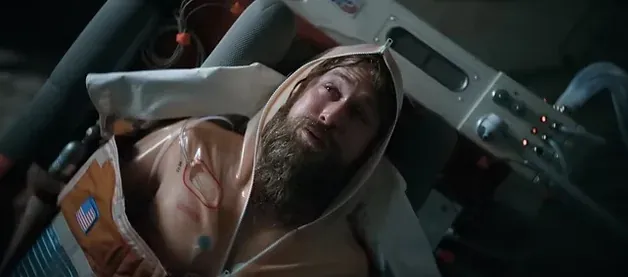
Andy Weir published Project Hail Mary in May 2021. By 2022 Drew Goddard had a draft. When directors Phil Lord and Chris Miller first screened their assembly cut, it ran 3 hours and 45 minutes. They described it as embarrassing. They cut 135 minutes. The film that released in 2026 runs 150 minutes.
We mapped the 2022 script through Quanten Arc and analysed the subtitle data from the final released film. What we found is that the structural DNA of the original script survived almost entirely intact. The bones that were there in 2022 are still there in 2026.
This post is about what those bones are, why they matter, and what anyone working in development, editing, or production can learn from how they were protected.
Two films, one creative team, two completely different philosophies
Start with the comparison that makes this interesting.
Andy Weir wrote both The Martian and Project Hail Mary. Drew Goddard adapted both novels into screenplays. Both films are science fiction survival stories. Both use a five act structure. On paper they are the closest possible comparison you could construct.
The data shows they are structurally almost opposites.
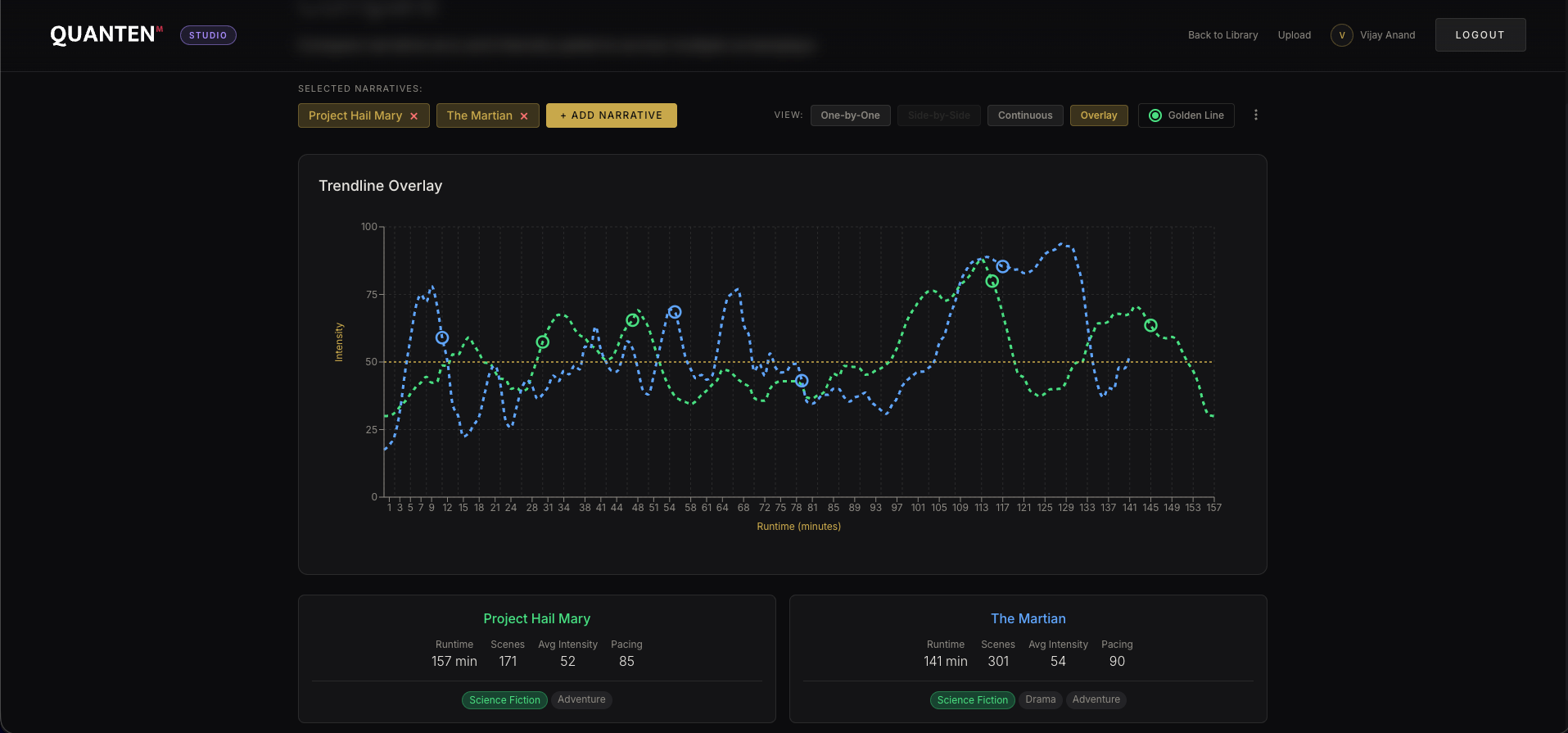
The Martian runs 141 minutes across 301 scenes. That is an average scene duration of 16.2 seconds. Project Hail Mary runs 150 minutes across 171 scenes. That is an average scene duration of 36.6 seconds.
Drew Goddard more than doubled his scene length between the two films. That is not a stylistic tweak. That is a fundamentally different theory of how to hold an audience.
The Martian has a pacing score of 90 and 29.6% high intensity scenes. Project Hail Mary has a pacing score of 85 and 21.6% high intensity scenes, with 55.6% sitting in the medium intensity band. The Martian is engineered for momentum. Project Hail Mary is engineered for immersion. One is built for a crowd to cheer. The other is built for a crowd to feel something they cannot quite name on the way out.
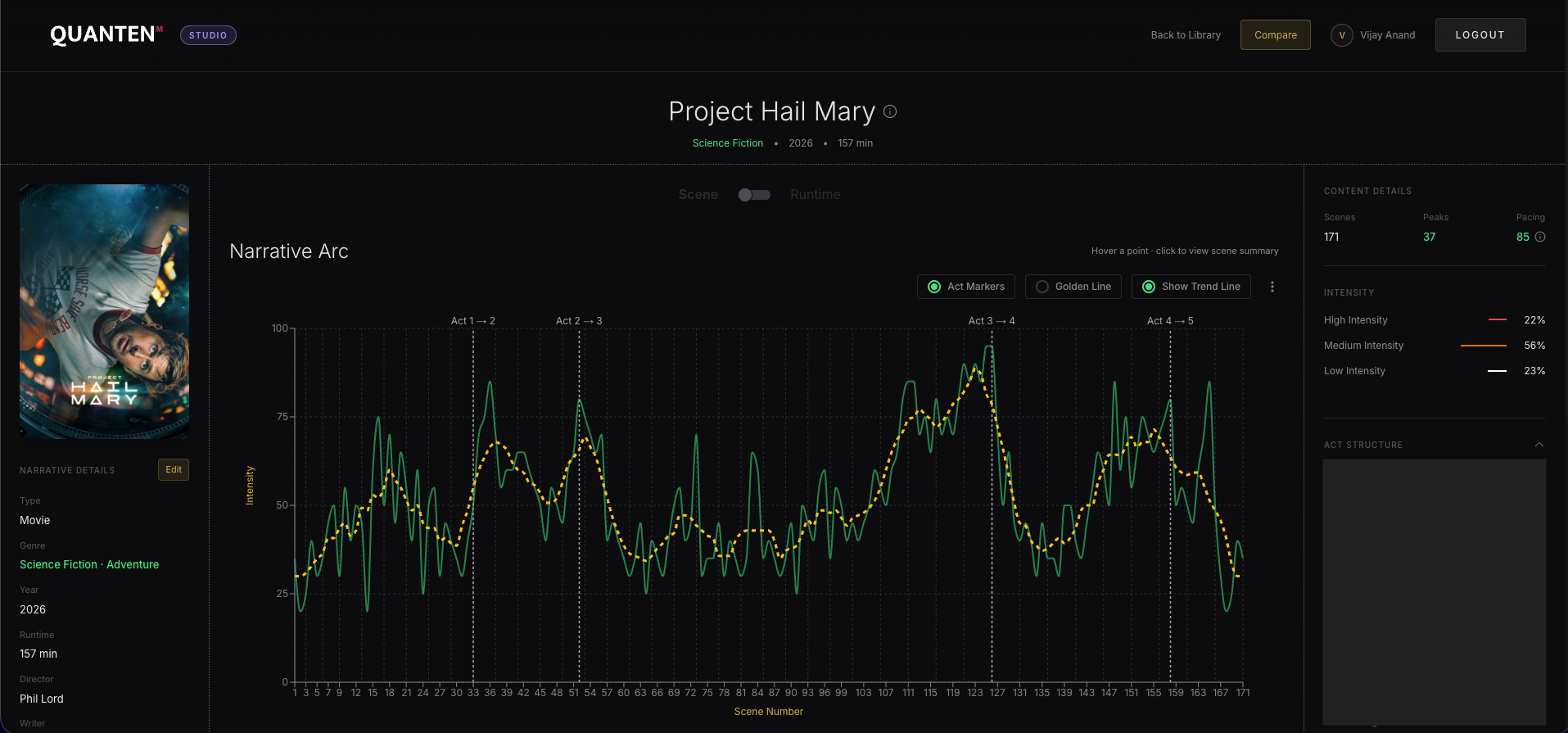
Both films build intensity across their runtime. The Martian concentrates almost all of that momentum in Act 5, which runs 52 scenes at an average intensity of 72.4 with 25 peaks. It is essentially one long sustained climax. Project Hail Mary distributes its momentum across Acts 2, 3 and 4, with Act 5 deliberately quiet at an average intensity of 47.3 and only 2 peaks.
Same author. Same screenwriter. Two completely different philosophies of what a film is for.
What the data would have told a development executive
Here is where the data earns its keep.
If a development executive had read the 2022 draft script with standard coverage tools, three notes would have been almost inevitable.
The first note: Act 2 is too short. At only 19 scenes it looks underdeveloped relative to the rest of the script.
The data shows the opposite. Act 2 has the highest average intensity of any act in the film at 61.3, with 5 peaks across those 19 scenes. It is the first contact sequence between Grace and Rocky. It does not need length. It needs precision. Giving it more scenes would have diluted the most concentrated dramatic moment in the entire script.
The second note: Act 3 is too long. At 74 scenes it looks like a pacing problem.
The data shows it is sustaining, not sagging. The average intensity across those 74 scenes holds at 53.2 with 20 peaks distributed evenly throughout. This is the Grace and Rocky relationship being built scene by scene. It cannot be rushed because the emotional payoff of the entire film depends on the audience believing in that partnership. Every scene is doing load-bearing work.
The third note: Act 5 is too quiet. At only 13 scenes with an average intensity of 47.3 and 2 peaks, it reads as a weak ending.
The subtitle data from the final released film confirms that Act 5 ends with 3.6 minutes of near silence before the final line: "Here I am, friend." The emotional climax has already landed in Acts 3 and 4. What follows is a resolution, not a climax. A taper, not a peak. The quiet ending is the right ending.
All three of those development notes would have been wrong. The data shows why before you shoot a single frame.
What the editor protected
The subtitle analysis of the final film reveals 16 major silences of 60 seconds or more across the 150 minute runtime. That is an editing philosophy, not a series of accidents.
The most significant silence falls at minute 46. It runs 4.1 minutes with no dialogue. It begins after the line "Blip D detected" and ends with "Is it me?" That is the moment Grace first properly encounters Rocky. The directors chose to let that moment exist in pure visual and sound design for over four minutes. No words. No explanation. Just the audience sitting with something they have never seen before.
That silence survived the cut from 3 hours 45 minutes to 150 minutes. In a film where 135 minutes ended up on the floor, a 4 minute silence that advances no plot and delivers no information was protected. That tells you everything about what Lord and Miller understood the film to be.
The final silence runs 3.6 minutes from minute 141.6 to 145.2, after "you're alright" and before "Here I am, friend." The film ends in near silence. The quiet Act 5 that the 2022 script data predicted is still in the release print, intact.
For any editor, the lesson here is specific. Silence is not absence. It is presence of a different kind. The 16 silences in Project Hail Mary are where the film does its most important emotional work. Cutting them in the name of pace would have cut the film's soul.
Why the DNA survived
This is the part the data cannot show on its own.
When the assembly cut came in at 3 hours 45 minutes, Lord and Miller knew something was wrong. They did not need a data tool to tell them that. What the data adds is the more precise question: once you start cutting 135 minutes out of a film, how do you know what to protect? How do you know which silence to keep and which scene to lose?
The answer in this case almost certainly has something to do with Andy Weir.
Weir wrote the novel. He stayed involved in the production. Drew Goddard, who adapted both of Weir's novels, understood the source material at a structural level deep enough to protect it across two completely different films over a decade apart. When the people closest to the original story stay in the room, the structural argument of that story has a guardian.
The bones of the 2022 script survived because the people who knew which bones mattered never left the building. The Act 2 precision was protected. The Act 3 patience was protected. The Act 5 quiet was protected. The silences were protected.
This is a lesson that goes beyond Project Hail Mary. The most common cause of structural drift in development is not bad notes. It is the gradual loss of people who understand why the story is built the way it is. When the original writer leaves. When the director changes. When the executive who championed the project moves on. Every departure is a risk to the structural argument, because the next person in the room does not know which notes would be wrong.
Authorial continuity is not just a creative value. It is a structural one.
The closing thought
Phil Lord and Chris Miller cut 135 minutes from their assembly cut. That is an entire film's worth of decisions about what mattered and what did not. The fact that the structural DNA of a 2022 script is still standing in the 2026 release is not luck. It is the result of people who understood what they were making and protected it all the way through.
The data shows what survived. The people in the room explain why.
The most expensive development note is the one that fixes something that was never broken.
Project Hail Mary is in cinemas now. The structural analysis in this post is based on a 2022 draft of the script and subtitle data from the released film. The 2022 script predates production by approximately four years and may differ from the shooting script.
Quanten Arc is a narrative intelligence platform for film and television development. arc.quanten.co/studio