AI Filmmaking Is Not Cheap as you think.

I keep seeing the same tweet. Some variation of: one prompt, one movie, zero budget. The future of cinema is here. The studios are dead.
I get it. The tools are genuinely remarkable. But I have been looking at some numbers this week and I want to share them with you, because they complicate the story in a way I find more interesting than the hype.
Higgsfield, the AI video platform, is making an 80-minute feature film entirely with AI. No cameras, no sets, no actors. 15 people. 14 days. They are taking it to Cannes. Before they started, they published exactly what the first 22 minutes of the project already cost them.
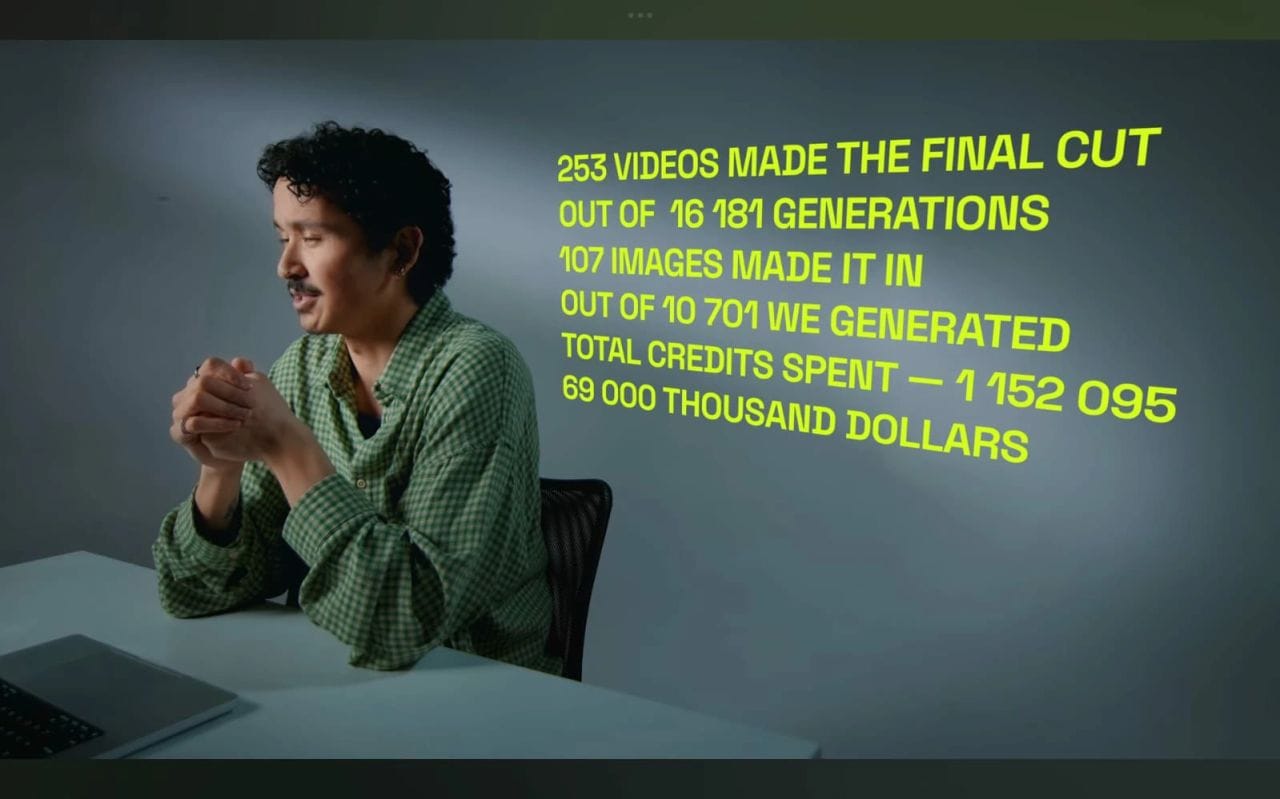
253 videos made the final cut. Those came from 16,181 generations. 107 images made it in. Those came from 10,701 generated. Total credits spent: 1,152,095. Approximately $69,000. For 22 minutes.
That is not including the 15 people on the team.
Chuck Russell, who directed The Mask and has been making Hollywood blockbusters for 30 years, watched the first episode. He said a traditional studio production of the same 22 minutes would cost a minimum of $5 million. So yes. AI filmmaking is cheaper. Dramatically cheaper. But it is not free and it is not one prompt.
OK but that show is giant mech bots fighting aliens
This is the rebuttal I would reach for too. Hell Grind is sci-fi. Of course it costs that much. All those impossible worlds, those creatures, that scale. Do a drama set in a kitchen and you are looking at a fraction of that.
Here is the thing though. I think the opposite is true.
Sci-fi and fantasy give AI filmmaking its greatest cover. When the world is alien and the aesthetic is deliberately strange, visual inconsistencies read as style. A character who looks slightly off in one shot, a texture that does not quite hold, a movement that feels uncanny. In a sci-fi universe, those things are forgiven. Sometimes embraced.
In a drama set in a kitchen, those same artifacts are immediately visible. Audiences have spent their entire lives in kitchens. They know exactly what a coffee cup looks like. How a person moves when they are nervous. What afternoon light does to a face. AI generation struggles most with exactly this kind of grounded, photorealistic, emotionally readable reality. The closer you get to the real world the more the seams show.
And then there is the second problem. Sci-fi carries its own spectacle. Explosions, battles, scale. These do the emotional heavy lifting when the story needs a moment to land. A drama or comedy has none of that. The emotional weight has to come entirely from dialogue, performance, and pacing. Three things that are the hardest to generate convincingly right now.
The genre you think would be cheaper is actually the genre that exposes every weakness in the technology most brutally. You can probably get very close with iterations, but that costs credits and that means budget goes up.
The 16,000 you do not see
Here is the thing Higgsfield said that I keep coming back to. Every generation that did not make it taught them the prompts for the next one. Masterpieces are not single prompts. They are the 16,000 you do not see.
That is actually a profound statement about craft. And it points to something important about cost. At $69,000 for 22 minutes, with a team that built the platform, every generation decision is a financial decision. A structural problem discovered at the generation stage costs money to fix. A structural problem discovered at the script stage costs nothing.
Higgsfield knew this. They spent three days finalising the script before a single credit was burned. A full canvas with style references, character sheets, location assets and shot lists. The story structure came first. The generation came after.
The economics of AI filmmaking only work if the story is sound before the credits start burning.